
Why Power Continuity Is a Business-Critical Requirement in the UAE
The UAE’s commercial landscape has matured rapidly. Businesses across Dubai, Abu Dhabi and the wider GCC now operate infrastructure that is deeply dependent on stable, uninterrupted power. Server rooms, point-of-sale systems, warehouse automation, CCTV networks, HVAC controls and communications equipment all share a common vulnerability: they cannot tolerate power interruptions, voltage fluctuations or sudden outages without risk of data loss, equipment damage or operational downtime.
While the UAE’s grid infrastructure is among the most reliable in the region, no utility supply is immune to transient voltage spikes, brief outages during peak demand periods or scheduled maintenance windows. For businesses where even minutes of downtime carry measurable financial consequences, relying solely on grid power without a protection and backup layer is an unacceptable risk posture.
Beyond continuity, energy cost management is an increasing priority. Commercial electricity tariffs in the UAE are structured around consumption and demand, and businesses with high or variable loads are exploring energy storage and solar integration to reduce grid dependency and manage operational costs more predictably. Simultaneously, the UAE’s national EV adoption targets are making commercial EV charging infrastructure a practical necessity rather than an optional amenity.
This article provides a structured overview of the four core energy solution categories relevant to UAE businesses today: UPS systems, energy storage, PV inverters and EV chargers. It is intended to help IT managers, facilities managers, procurement teams, system integrators and electrical contractors make informed decisions when evaluating requirements and selecting solutions.
Understanding UPS Systems: Function, Types and Applications
An uninterruptible power supply, commonly referred to as a UPS, is a device that provides near-instantaneous backup power to connected equipment when the primary power source fails or degrades below acceptable thresholds. It also conditions incoming power, filtering out voltage spikes, sags and electrical noise that can damage sensitive electronics over time.
How a UPS Works
A UPS maintains a charged battery bank and, depending on its topology, either passes conditioned mains power through to the load or continuously powers the load from its inverter while simultaneously keeping the battery charged. When mains power fails, the transition to battery is either instantaneous or occurs within milliseconds, depending on the UPS type. This window is short enough to protect most electronic equipment from the effects of an outage.
UPS Topologies
There are three principal topologies relevant to commercial buyers. An offline or standby UPS is the most basic form, suitable for desktop computers and low-criticality peripherals. A line-interactive UPS adds automatic voltage regulation, making it appropriate for networking equipment, small server environments and retail point-of-sale systems. An online double-conversion UPS continuously converts incoming AC power to DC and back to AC, providing complete isolation from the mains supply and the highest level of power conditioning. This topology is the standard for server rooms, data centres, medical equipment and any application where power quality is as important as continuity.
Where UPS Systems Are Deployed in UAE Businesses
Commercial UPS deployments in the UAE span a wide range of environments. Server rooms and network closets require online UPS systems sized to the IT load with sufficient runtime to allow for a controlled shutdown or generator transfer. Retail outlets rely on UPS protection for POS terminals, payment systems and security equipment. Office environments use UPS systems to protect workstations, VoIP infrastructure and access control systems. Warehouses and logistics facilities protect inventory management systems, barcode scanners and automated conveyor controls. Hospitality properties protect front-desk systems, in-room controls and back-of-house IT infrastructure.
Energy Storage Systems: Beyond Backup Power
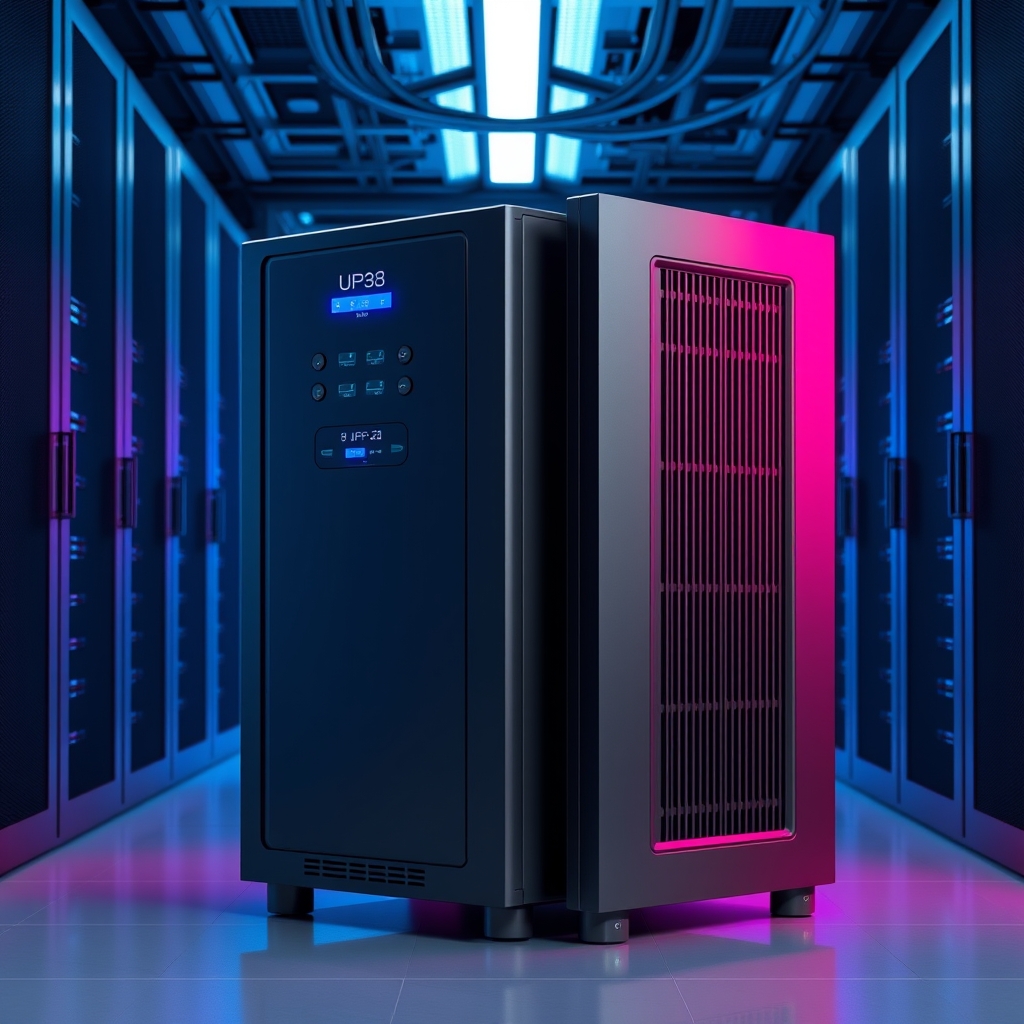
While a UPS is designed primarily to bridge the gap between a power failure and either restoration of supply or generator start-up, an energy storage system, often referred to as a battery energy storage system or BESS, serves a broader set of functions. The distinction is important for buyers evaluating their requirements.
What Differentiates Energy Storage from UPS
A UPS is optimised for short-duration, high-reliability backup of specific critical loads. Its battery capacity is typically sized for minutes to a few hours of runtime. An energy storage system is designed for longer-duration storage and discharge cycles, often integrated with renewable generation sources or used for load shifting, peak demand reduction and grid services. BESS units are typically modular, scalable and designed for daily charge and discharge cycles over a service life measured in years.
For a UAE business, the practical distinction is as follows. A UPS protects a server room from a fifteen-minute outage. An energy storage system can store solar energy generated during daylight hours and discharge it during evening peak periods, reducing grid consumption and managing electricity costs across the full operating day.
Commercial Applications of Energy Storage in the UAE
Commercial and industrial energy storage is gaining traction in the UAE across several sectors. Warehouses and logistics facilities with high daytime cooling loads are using storage to reduce peak demand charges. Retail developments and commercial towers are integrating storage with rooftop solar to reduce grid dependency. Hospitality properties are using storage to provide resilience against outages while simultaneously managing energy costs. As battery technology costs continue to decline and UAE regulatory frameworks for distributed energy resources mature, the commercial case for energy storage is strengthening across a wider range of business sizes and sectors.
PV Inverters: The Core of Any Solar Energy System
Solar photovoltaic panels generate direct current electricity. The electrical infrastructure of commercial buildings, and the national grid itself, operates on alternating current. A PV inverter is the device that performs this conversion, making solar-generated electricity usable within a commercial facility and, where applicable, exportable to the grid.
Types of PV Inverters for Commercial Use
String inverters connect multiple solar panels in series and convert the combined DC output to AC. They are cost-effective and well-suited to commercial rooftop installations where panels are uniformly oriented and shading is minimal. Hybrid inverters combine the functions of a solar inverter and a battery charge controller in a single unit, enabling integration of both solar generation and energy storage within a unified system. This topology is increasingly relevant for UAE businesses seeking to combine solar generation with backup power or load-shifting capability. Three-phase inverters are the standard for commercial and industrial installations where the building’s electrical supply is three-phase, which is the case for most commercial premises in the UAE above a certain scale.
Why PV Inverter Selection Matters
The inverter is the most technically complex component in a solar energy system and has a direct impact on system efficiency, reliability and monitoring capability. An undersized or poorly matched inverter limits the output of the entire array. A hybrid inverter that is not compatible with the chosen battery chemistry or capacity creates integration problems that are costly to resolve after installation. For system integrators and electrical contractors specifying solar solutions for commercial clients in the UAE, inverter selection requires careful attention to load profile, battery integration requirements, grid connection regulations and monitoring requirements.
EV Chargers: Becoming Standard Business Infrastructure
The UAE government has set clear targets for electric vehicle adoption as part of its broader sustainability agenda. The practical consequence for commercial property owners, retailers, hospitality operators, logistics businesses and corporate campuses is that EV charging infrastructure is transitioning from a differentiating amenity to an expected facility.
Commercial EV Charging Categories
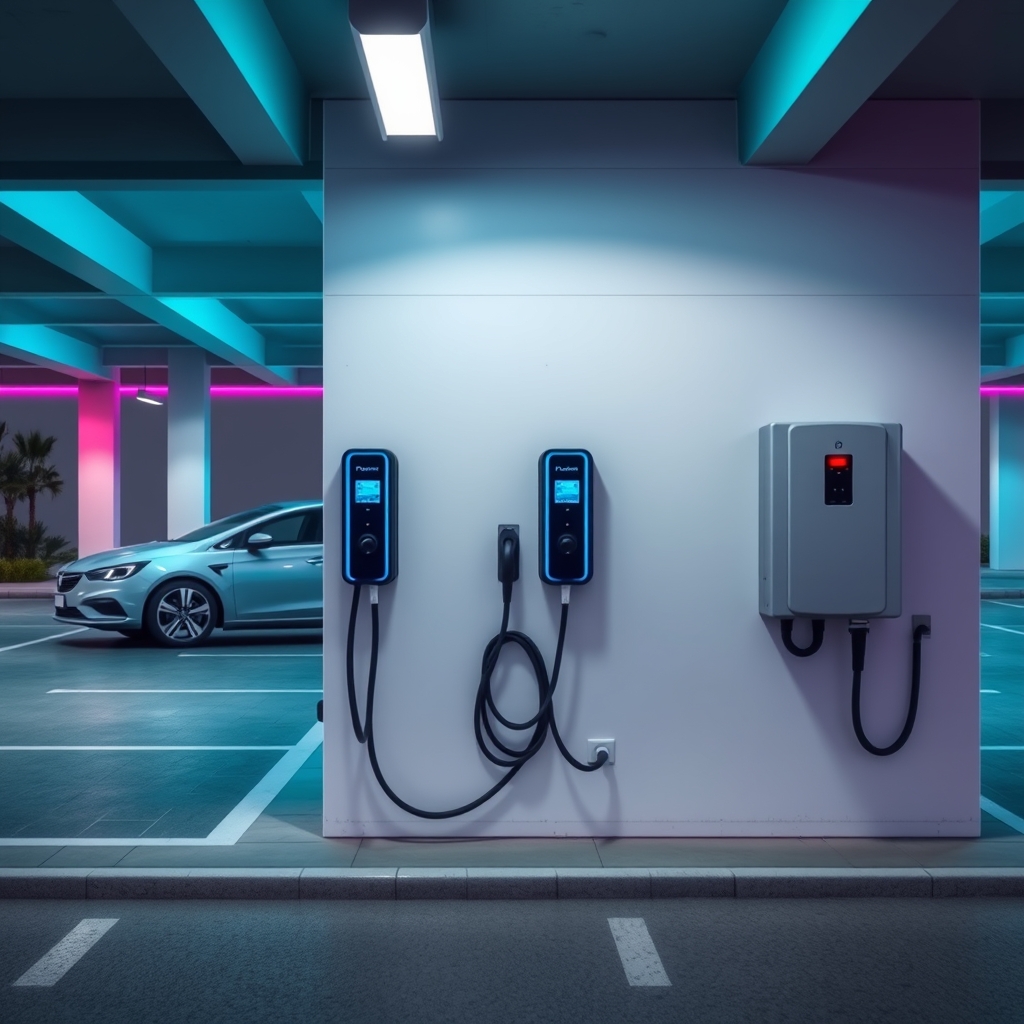
AC Level 2 chargers, typically rated between 7 kilowatts and 22 kilowatts, are suited to workplace charging, hotel parking, retail destinations and any location where vehicles are parked for extended periods. They are wall-mounted, straightforward to install and cost-effective to operate. DC fast chargers deliver significantly higher power levels and are appropriate for service stations, logistics hubs, fleet depots and locations where rapid turnaround is required. For most commercial property and workplace applications in the UAE, AC Level 2 infrastructure represents the practical starting point, with the electrical infrastructure designed to accommodate future capacity expansion.
Business Considerations for EV Charger Deployment
Installing EV charging infrastructure involves electrical capacity assessment, load management to avoid peak demand spikes, network connectivity for access control and billing, and compliance with local authority requirements. Businesses integrating EV chargers with solar generation and energy storage can manage charging loads more efficiently, reducing grid demand during peak periods. For facilities managers and procurement teams, EV charger deployment is increasingly part of a broader energy infrastructure conversation rather than a standalone project.
Common Use Cases Across UAE Business Sectors
The following scenarios illustrate how these four solution categories intersect in practice across the business environments most commonly encountered in the UAE.
Server Rooms and Data Centres
An online double-conversion UPS sized to the IT load, with sufficient battery runtime for generator transfer, is the baseline requirement. Larger facilities may integrate modular UPS architecture for scalability and redundancy. Energy storage is relevant where generator dependency is to be reduced or where extended runtime beyond conventional UPS battery capacity is required.
Retail and Hospitality
Retail outlets require UPS protection for POS, payment terminals and security systems. Hotels and resorts benefit from UPS coverage of front-desk and back-of-house IT, combined with energy storage and solar integration to manage the significant electricity costs associated with large-scale HVAC and lighting loads. EV chargers in hotel car parks are increasingly a guest expectation in the UAE market.
Offices and Corporate Campuses
Office environments require UPS protection for network infrastructure and workstations. Corporate campuses with significant roof area are well-positioned for solar and storage integration. Workplace EV charging is becoming a standard consideration in corporate facilities planning, particularly for organisations with sustainability commitments or staff retention objectives.
Warehouses and Logistics Facilities
Warehouses have high and variable power loads, significant roof area suitable for solar, and operational systems that require UPS protection. Fleet electrification is an active consideration for logistics operators, making depot-level EV charging infrastructure a near-term requirement for a growing number of businesses in this sector.
Buyer Checklist: Key Considerations Before Selecting a Solution
Before engaging a supplier or specifying a solution, buyers and their technical advisors should work through the following considerations to ensure the selected products are appropriate for the application.
Load Assessment
Identify the critical loads that require protection or backup. Quantify total power consumption in kilowatts and assess the load profile over time. For UPS selection, determine the required runtime. For energy storage and solar, assess daily and seasonal consumption patterns.
Site Electrical Infrastructure
Confirm whether the site supply is single-phase or three-phase. Assess available electrical capacity for additional loads such as EV chargers or battery storage systems. Identify any constraints on inverter or UPS installation locations, including ventilation, access and weight-bearing requirements for battery systems.
Integration Requirements
Determine whether the UPS, storage, solar and EV charging systems need to operate as an integrated ecosystem or as independent installations. Hybrid inverter solutions that combine solar and storage management simplify integration but require careful specification to ensure compatibility across components.
Scalability and Future-Proofing
Assess whether the solution needs to accommodate load growth, additional solar capacity or expanded EV charging over a three-to-five-year horizon. Modular UPS and battery storage architectures provide flexibility that fixed-capacity systems do not.
Monitoring and Management
Evaluate the monitoring and remote management capabilities of the proposed solution. For facilities managers overseeing multiple sites, centralised energy management visibility is a practical operational requirement. For data centre and IT teams, UPS monitoring integration with network management systems is standard practice.
Regulatory and Grid Connection Compliance
In the UAE, grid-connected solar and storage systems are subject to regulatory requirements that vary by emirate and utility provider. Confirm that the proposed solution meets applicable standards and that the installation contractor is familiar with local authority approval processes.
KSTAR Energy Solutions: NEWCOM’s Portfolio for UAE and GCC Partners
NEWCOM distributes KSTAR energy solutions across the UAE and GCC, providing channel partners, system integrators, electrical contractors and corporate buyers with access to a range of products that address the full spectrum of commercial power protection and energy management requirements.
KSTAR’s product portfolio covers online UPS systems in single-phase and three-phase configurations, modular UPS architecture for scalable data centre and critical infrastructure deployments, lithium battery energy storage systems, hybrid PV inverters for solar and storage integration, and commercial AC EV chargers. The range is designed to address the requirements of the use cases described in this article, from small server room protection to large-scale commercial energy infrastructure.
NEWCOM’s role is to provide partners with product availability, technical pre-sales support, configuration guidance and the supply chain reliability that commercial projects require. Partners working on energy infrastructure projects for corporate clients, commercial developments or public sector facilities can engage NEWCOM’s team to discuss requirements, obtain product specifications and access the support needed to deliver solutions with confidence.
To explore KSTAR energy solutions for UPS systems, energy storage, PV inverters or EV charging requirements, contact the NEWCOM team or speak with your account manager.
Frequently Asked Questions
What size UPS does a typical small server room in the UAE require?
The appropriate UPS capacity depends on the total power draw of the connected equipment, measured in kilowatts or kilovolt-amperes, and the required runtime. A small server room with a load of 3 to 10 kVA and a runtime requirement of 10 to 30 minutes is a common starting point. An online double-conversion UPS is the recommended topology for server room applications. A qualified pre-sales engineer should review the load list and runtime requirement before specifying capacity.
What is the difference between a UPS and a battery energy storage system for a commercial application?
A UPS is designed to protect specific critical loads from short-duration power interruptions and power quality issues, typically providing minutes to a few hours of runtime. A battery energy storage system is designed for longer-duration storage and daily charge-discharge cycling, often integrated with solar generation for load shifting, peak demand management or extended backup. The two technologies serve complementary but distinct purposes and can be deployed together in the same facility.
Do businesses in the UAE need regulatory approval to install a grid-connected solar PV and storage system?
Yes. Grid-connected solar and battery storage installations in the UAE are subject to regulatory requirements that vary by emirate and utility provider. Businesses should confirm applicable standards and approval processes with the relevant authority before proceeding. Working with an experienced system integrator or electrical contractor familiar with local requirements is advisable.
What type of EV charger is appropriate for a commercial car park or workplace in the UAE?
For most commercial car parks, retail destinations, hotels and workplace applications, AC Level 2 chargers rated between 7 kW and 22 kW are the practical and cost-effective choice. They are suitable for vehicles parked for extended periods and are straightforward to install. DC fast chargers are more appropriate for fleet depots, service stations or locations where rapid turnaround is required.
How can NEWCOM support channel partners and system integrators working on energy infrastructure projects?
NEWCOM provides channel partners and system integrators with access to the KSTAR energy solutions portfolio, including UPS systems, energy storage, PV inverters and EV chargers. NEWCOM offers technical pre-sales support, product configuration guidance, competitive pricing and reliable supply chain access for projects across the UAE and GCC. Partners can engage the NEWCOM team to discuss specific project requirements.